Fealty's Blade: Honor and the Heart's Sacrifice
Roland's oath to Charlemagne brought him glory, but left me a widow before I was a wife.
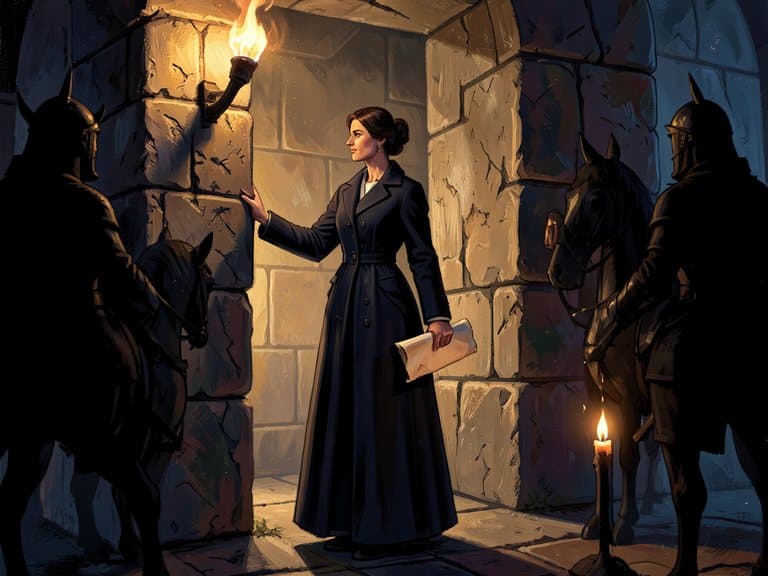
They speak of Roland’s valor in the mountain passes, of his horn that split the air, of Durendal striking through the paynim host. They do not speak of what the horn’s echo sounds like in a quiet hall, when the tapestry frames a face that will never return. I have heard the song sung at court, and I have held my peace—for duty binds the tongue as well as the sword.
From my earliest remembrance, I knew the weight of fealty. My brother Oliver gave his hand to Roland before my own heart did, for their oath to the emperor tied them closer than any marriage vow. I watched them ride out from Vienne, their banners bright, their laughter sharp as steel. They were bound to God, to France, to Charlemagne—and I was bound to both of them through the slender thread of a betrothal that was also a political knot. My father, Duke Girart, sealed it with a clasp of hands. No priest murmured over us; no ring passed. The promise was enough. In our world, a promise is iron.
So I learned to measure time by the seasons of war. Spring brought the call to muster; summer dried the blood on the plains; winter was for waiting. I kept his chambers ready—wax for his seal, wool for his cloak, a chair placed to face the door. That chair is empty now, and I cannot bring myself to have it moved. Fealty does not end with the death of the knight; it becomes a ghost that sits beside you at every meal.
They tell me I am honored. Roland’s name will be sung for a thousand years. The Twelve Peers will be remembered as long as men speak of courage. And I? I am the lady who fainted at the news, who later refused all other lords. Some call it constancy; others call it folly. I call it the cost of loving a man who was never wholly mine. He belonged first to Charlemagne, then to the rearguard, then to the horn’s last breath. I had only the husk of his promise, and the memory of his hand upon mine at the betrothal feast—a hand that was already sword-callused and restless for battle.
Perhaps the cruelest part of fealty is that it demands the whole self. Roland could not serve his emperor with half a heart, nor love me with the half that remained. When he rode to Roncevaux, he carried my favor in his helm—but he carried Ganelon’s treachery in his thoughts, and the need to prove his loyalty in every blow he struck. The oath to Charlemagne was not merely a duty; it was the very air he breathed. I understood this. I accepted it. I even admired it. But acceptance does not fill the silence of an empty bedchamber.
I have heard the jongleurs sing of the scene at court when Charlemagne brought the news. They say I wept, then fell, then died of a broken heart within the hour. The song is not true. I did not die so quickly. I live still, in a chamber that overlooks the fields where the dust of his passing has long settled. I take my meals, I speak with my women, I receive visitors who offer condolences I cannot honorably refuse. And I think—constantly—about the choice I did not make. If I could have asked him to stay, to break his oath, to let another man take the rearguard… would I? I tell myself no. I tell myself that I loved him because he was a man of his word. To ask him to be false would have been to love a shadow, not the man.
This is the paradox of fealty: it elevates the soul even as it breaks the heart. Roland’s name is sung not because he survived, but because he did not turn. My name is sung only in passing, as the price of that glory. Yet I will hold my head high when the minstrels come to Aix. I will let them see that my eyes are dry and my hands are steady. I am the keeper of a promise that outlived the one who made it. That is a kind of fealty too—one that has no emperor to reward it, and no seat at the Round Table. But it is the only truth I have.
So let the poets write of Durendal and the horn. I will write my own verse, in the language of a patience that becomes exhaustion, of a loyalty that becomes a cage. There is honor in it. There is also a kind of death that no enemy’s sword can bring. I have died a little every day since the news came, and yet I am still here, still keeping the chair facing the door, still faithful to a ghost. That is the cost of fealty. I have paid it, and I will pay it still, for as long as the tale of Roland is told.