The Eye of Tepegöz: A Mirror to Our Honor
To strike the giant is not merely to fell a beast, but to reclaim the severed dignity of the Oghuz k
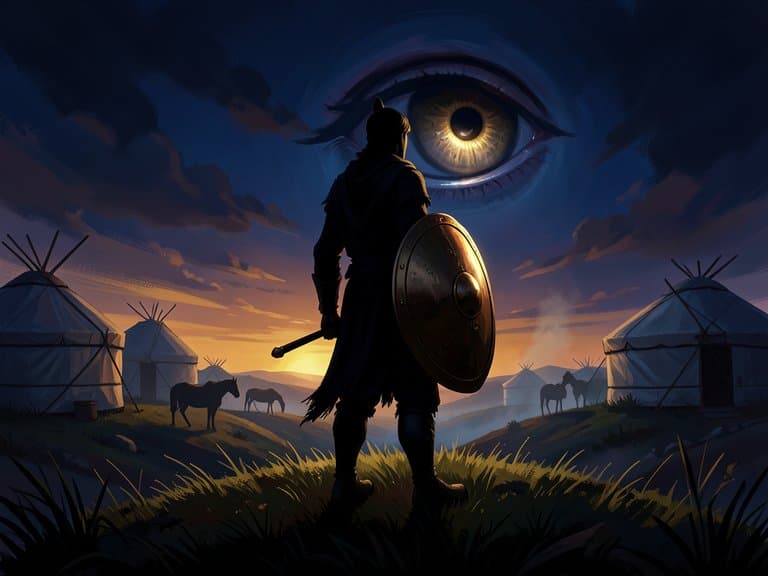
In the high pastures where the grass bends to the wind and the smoke of our tents rises to meet the sky, a man is judged not by the length of his life, but by the weight of his word and the sharpness of his steel in defense of his people. Listen well, as the elders teach. There are shadows that fall upon the land that are not cast by clouds, but by our own failings and the trials sent to test the marrow of our bones.
Many singers of tales speak of Tepegöz, the one-eyed cyclops, as a mere horror born of a shepherd’s folly and a peri’s curse. They speak of his hunger for men and his skin that no sword could bite. But I tell you, as one who felt the heat of his breath and the stench of his lair, that the giant was more than a monster. He was a reckoning. He was a living testament to what happens when the circle of the kin is broken and when the laws of our ancestors are ignored.
When Tepegöz laid waste to our flocks and devoured our sons, he did not just consume flesh; he consumed our peace. He forced the Oghuz—the brave, the unyielding—to pay a tribute of blood. When a people begin to bargain with their own destruction, when they count out their youths like sheep to be led to a slaughter-pit just to buy another day of fearful silence, their honor is already half-dead. The giant was a mirror held up to our faces, reflecting a cowardice that no gold or silk could hide.
I remember the day I returned to the encampment. I saw my brother, Kıyan Selçuk, and the other lords of the Oghuz looking at the ground, their eyes hollowed by the shame of their helplessness. They had tried to fight him with numbers, with brute force, and with desperate bargains. But you cannot defeat a test of honor with the tools of a merchant.
By the law of the kin and the strength of the sword, I knew that my blade alone would not suffice. The giant’s hide was charmed, yes, but his true power lay in the fear he planted in the hearts of my father, Aruz, and the great Bayindir Khan. To kill the beast, I had to first kill the idea that we were victims.
I went into that cave not as a hunter seeking a trophy, but as a son fulfilling a debt. I wore the skin of a sheep to deceive him, not because I lacked courage, but because the wise warrior knows that when a mountain stands in your way, you do not beat your head against the rock; you find the vein that makes it crumble. When I heated the spit in the fire and drove it into his single, lidless eye, I was not just blinding a creature. I was closing the eye that watched our shame. I was shattering the gaze that had forced the Oghuz to look away from their own greatness.
When he lay dying, and he spoke to me, trying to lure me with riches and false brotherhood, I did not waver. A monster remains a monster, but a man must remain a man. To have spared him for his gold would have been a deeper sin than the deaths he caused. It would have meant that Basat’s soul could be bought. And if a hero’s soul has a price, then the kin has no foundation.
I brought his head back to the tents of the Oghuz. Not to boast, though a warrior’s reputation is his only true inheritance, but to show my elders that the nightmare had ended because we reclaimed our right to resist. We had stopped paying the blood-tribute. We had remembered who we were.
Let this be a lesson for those who walk the earth today. Whenever a shadow grows too large, whenever a threat demands that you sacrifice your dignity for your safety, remember the cave of Tepegöz. The giant is never just a beast of meat and bone. He is the physical form of our own hesitation. Strike him where he is most vulnerable—not in his heart of stone, but in the pride he thinks he has stolen from you.
Our stories are not told to pass the time by the fire. They are told so that when the next giant rises—and he will rise, in another form, in another age—the sons of the Oghuz will know that their honor is a shield that no magic can pierce.